> ## Documentation Index
> Fetch the complete documentation index at: https://docs.reframe-video.com/llms.txt
> Use this file to discover all available pages before exploring further.
# The loop
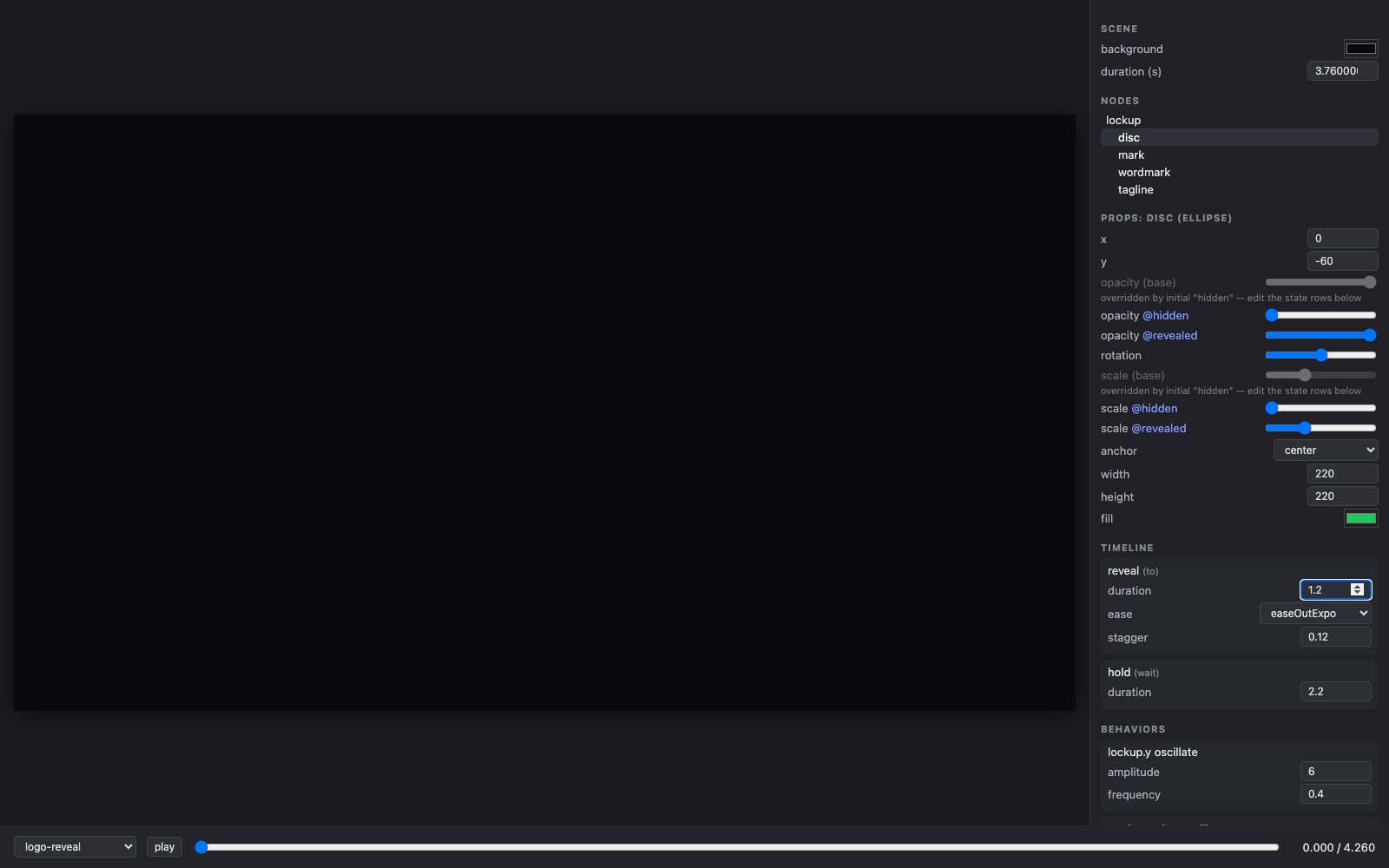
> AI writes the scene, a human tweaks it, the render is deterministic — and the tweaks survive the next regeneration.
```mermaid theme={null}
flowchart LR
S["scene.ts
you · or an AI given 'reframe guide'"] --> IR["IR
plain JSON data"]
IR --> P["preview
scrub + knobs"] --> O["overlay JSON
non-destructive edits"]
IR --> R["render
deterministic mp4
same input → byte-identical"]
O -. reapplies even after an AI
regenerates the base .-> R
```
Everything is a pure function of time: `evaluate(scene, t)` — no wall clocks, no randomness without a seed, so scrubbing and distributed rendering come for free. `reframe lint` *enforces* it: the scene is compiled twice and any IR that differs (a `Math.random()` or `Date` baked into a prop) is flagged, so a scene that would render differently each time fails the gate before you ship it.
## How edits survive regeneration
Overlays address the scene by **node id, state name, and timeline label** — never by position or index. When an AI regenerates a scene it follows one contract ([the regeneration contract](/guides/regen-contract)): keep those names stable for every concept that survives the redesign. When the contract is broken anyway, `composeScene` skips the affected edits and reports them with a diagnosis naming the likely rename. The failure hierarchy:
1. Contract followed (the measured common case) → edits survive.
2. Contract broken → loud orphan report.
3. Never: silent edit loss, or a render failure caused by base drift.
## Restructure, not just re-skin
An overlay isn't limited to patching props and timing — it can change the **structure** of the cut, keyed by the same stable addresses, and those edits survive regeneration too:
* **Reorder** a beat — patch `timeline..order`; beats move as whole units, so child labels and any edits on them ride along.
* **Remove** a beat — `removeTimeline: ["shot-3"]` splices it out by label; later steps ripple up.
* **Insert** a whole new unit — `insertNodes` adds the node tree and `insertTimeline: { into: "montage", after: "shot-2", step }` splices its beat into a named parent.
A montage is built so each shot is the self-contained beat `shot-${i}`, so an overlay can drop, reorder, or splice in a card without touching the base. Try it on the pure-vector demo (no assets needed):
```bash theme={null}
reframe verify-overlay examples/scenes/vector-montage.ts \
examples/overlays/vector-montage-restructure.json # 4 applied, 0 orphaned
reframe render examples/scenes/vector-montage.ts \
--overlay examples/overlays/vector-montage-insert.json # a new card spliced into the cut
```
See the [regeneration contract](/guides/regen-contract) for the full structural-edit vocabulary and overlay JSON schema.
 ## Address-keyed everything
The same stable-address namespace powers more than hand edits:
* **Batch**: every data row is an overlay. Row keys are addresses (`nodes.name.content`, `timeline.enter.duration`) — N personalized deterministic videos from one template, in parallel.
* **Sound**: `audio.cues` anchor to timeline labels, so retime a step (or regenerate the scene) and the sound design moves with it.
* **Tooling**: `reframe manifest` dumps a scene's editable surface; `reframe verify-overlay` proves an overlay still applies after a regen; `reframe lint` flags motion that has no stable address *and* verifies the scene is deterministic. See the [CLI reference](/cli-reference) for the full command surface and the [programmatic API](/api) to embed it.
## Address it before you render
Because the scene is data, structure validates **before** any pixels — wrong props, unknown labels, off-frame addresses surface as actionable errors, and motion is computable straight from the IR. The errors are structured, not prose: `reframe compile --json` returns `{ ok: false, kind, issues: [{ code, path, message }] }`, so an agent or a UI can point at the exact broken node.
The regeneration contract — the exact rules an AI follows so edits reapply.
## Address-keyed everything
The same stable-address namespace powers more than hand edits:
* **Batch**: every data row is an overlay. Row keys are addresses (`nodes.name.content`, `timeline.enter.duration`) — N personalized deterministic videos from one template, in parallel.
* **Sound**: `audio.cues` anchor to timeline labels, so retime a step (or regenerate the scene) and the sound design moves with it.
* **Tooling**: `reframe manifest` dumps a scene's editable surface; `reframe verify-overlay` proves an overlay still applies after a regen; `reframe lint` flags motion that has no stable address *and* verifies the scene is deterministic. See the [CLI reference](/cli-reference) for the full command surface and the [programmatic API](/api) to embed it.
## Address it before you render
Because the scene is data, structure validates **before** any pixels — wrong props, unknown labels, off-frame addresses surface as actionable errors, and motion is computable straight from the IR. The errors are structured, not prose: `reframe compile --json` returns `{ ok: false, kind, issues: [{ code, path, message }] }`, so an agent or a UI can point at the exact broken node.
The regeneration contract — the exact rules an AI follows so edits reapply.